
I get asked about how do I go about cleaning a firearm. The process anyway. The best question I get is how often? Well, lets talk about this.
If you search online the process in which to clean a firearm and how often, can be confusing. It’s kind of like lasagna. Everyone has their way. It’s not complicated, rather simple. There is a whole lot of different products out there to assist in the endeavor. I’m old school and I’m sure there are probably better ways. But I have seen other gunsmiths clean guns from taking the gun completely apart and scrubbing the finish off to just wiping the firearm down and calling it good. These are extremes. But I am not exaggerating either.
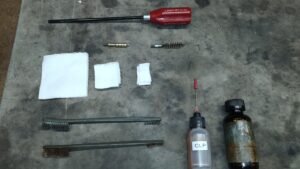
The items I use are:
Cleaning rod: Long enough to go through the barrel being cleaned. Preferably nylon coated or sleeved.
Brushes: Military cleaning brushes are the best, nylon and bronze work really well.
Bore brush: These come in caliber, such as .22, .30 , 9mm, .40 etc. i prefer a bronze brush.
Jag or hoop: These come in caliper as well. I prefer the jag.
Shop rag or towel: Paper towels will work well as a cloth shop rag. Either can be purchased from an automotive supply house. I usually use old t-shirts and cut them up.
Flannel cleaning patches: Usually sold at your local gun store or off the internet. 2″ x 2″ patches can be cut down to smaller sizes to fit smaller caliber barrels.
Cleaning solvent: I prefer Hopes no9. Works really well on dissolving and loosing spent powder carbon.
Water displacing oil or lubricant: I like WD40. There are other oils out there that work pretty good, Find something that works good for your preference.
Gun grease: White lithium works well.
CLP oil; Any good quality gun oil for lubrication. Rem Oil works well also.
Q-tips: These come in different lengths, shapes and sizes. I use the regular ones you find a the drug store.
Other chemicals: Acetone or break cleaner are good for removing moisture and dissolving carbon and residual powder build up.
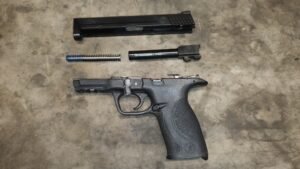
First and foremost, check and remove any ammunition from the firearm. Once this is done proceed to dismantling the firearm per manufacturers directions to be cleaned. This is usually termed “field stripping”.
Cleaning the barrel;
Thread the bore brush onto the tip of the cleaning rod. Open the bottle of solvent and dip the brush into the solvent. Insert the brush end of the cleaning rod into the barrel and push all the way through. Do not stop midway through. The brush will get stuck and could cause damage to the barrel. Make several complete strokes through the barrel. Wipe the cleaning rod off with a shop towel. Remove the bore brush and thread on the jag. Cut a cleaning patch down into smaller squares until it is to the size caliber of the firearm. A patch for a .22 would be smaller than a 9mm or 30 caliber patch. insert a patch to the tip of the jag. Push the patch end into the barrel and briskly stroke the patch through to the end of the barrel. Repeat until the cleaning patch comes out clean.
Cleaning the frame or receiver;
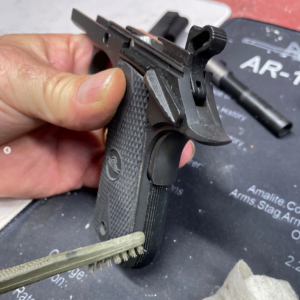
Dip the small end of the cleaning brush in to the solvent. Using the brush, scrub, powder, dirt, and carbon from any corners, grooves and notches in the receiver. Use either a shop towel or cleaning patches to wipe the debris away. Do the same for any loose parts, such as springs or pins that were removed during the dismantling of the firearm. If the trigger mechanism is to be removed separately, gently scrub any dirt and debris from the mechanism.
Lubrication;
Here is where a lot of people screw up. Some times less is more in most situations. A drop will do ya. I use CLP to lubricate contact points of springs and pins in trigger mechanisms. Any where two surfaces come together. Such as triggers, sears and the hammer. Like I mentioned, a drop will do. Grease any high friction areas, like where the bolt slides back and forth. Use a Q-tip with grease and lube the grooves of a slide or in a receiver where the bolt rides in the grooves of the receiver. Once again, a little will go a long way. Take a shop towel and spray a generous amount of WD40 into it. Saturate the towel. Not to excessive. Just enough to make a really oily cloth. With this cloth wipe all the firearm parts to a thin coating. Not dripping.
Reassemble the firearm;
After which use the oily shop towel and wipe down the firearm. Now when you wipe down the firearm, it should not be oily. If so, use a clean, dry towel and wipe off any excess. Your done.
By now your asking, ” What’s with the break cleaner and acetone?” Good Question. I use these in situations where the firearm is so dirty, like that .22 rifle in the back of the closet that has been shot to death and never cleaned. I will soak the parts in acetone to loosen the dirt and debris. Sometimes over night. Then brush as much as I can with the bronze or nylon cleaning brush. The break cleaner, I use in situations where there is a lot of dirt and debris in trigger mechanisms, such as in shotguns. Both do real good at removing moisture and oil. Especially from skin. These chemicals are harmful. Please wear the appropriate gloves and safety glasses.
Remember Lasagna? This is where that comes in. I’m not saying the process and materials I use are the best. The process I use works well. It works well for me. I clean a firearm to preserve it so the next time I use it, it functions the way it is supposed to. My carry as well. I want to be confident that “IF” I ever have to use that firearm, it will dependably discharge.
Other ways;
There are Sonic cleaners, pull ropes and cables. Specialized process cleaning kits out there that some swear by. There are cleaning kits that are able to clean an arsenal of different firearms. Then there are cleaning kits out there that are applicable to a certain caliber and firearm. Such as pistol, rifle or shotgun. To start keep it simple. Cleaning rod, rag, patches, powder solvent, bore brush and jag for the firearm you have.
When to clean a firearm;
Well, that depends. For the most part, after every time you shoot. Competitive shooters may not completely clean their firearms after every match but will completely clean them before storing them. To some extent they clean their firearms and inspect them. Hunters, a good wipe down after coming out of woods or blind, then a complete cleaning at the end of the season. The monthly range shooter, yeah, clean after a day at the range. The occasional shooter, yes, after every time they shoot. That carry gun that sits in a holster, take it out clean it at least once a month. That gun that stays in the center console that is packed with ketchup, taco sauce and rinsed with spilt diet Coke, yeah, cleaning it often would be a good idea.
Everyone loves to shoot their firearms, cleaning not so much. You can do it or you can pay me. I’ll be more than happy to do it for you. Either way, it is part of the responsibility of being a firearm owner. Just as the car. It gets washed and the oil changed. Right? Well, the same goes for the pistol or rifle too. Take care of your tools and your tools will be there when you need them. If not, well, bad things can happen. American Gun Institute(AGI) has a video, I recommend, on how to clean a firearm. The video might help in better understanding the process.
Thanks again for stopping by,
Rod Rice
Your Hero Support